Vehicular Pollution

Vehicular Pollution
Vehicular Pollution

The large majority of today’s cars and trucks travel by using internal combustion engines that burn gasoline or other fossil fuels. The process of burning gasoline to power cars and trucks contributes to air pollution by releasing a variety of emissions into the atmosphere.

Emissions that are released directly into the atmosphere from the tailpipes of cars and trucks are the primary source of vehicular pollution. But motor vehicles also pollute the air during the processes of manufacturing, refueling, and from the emissions associated with oil refining and distribution of the fuel they burn.

Primary pollution from motor vehicles is pollution that is emitted directly into the atmosphere, whereas secondary pollution results from chemical reactions between pollutants after they have been released into the air.


Despite decades of efforts to control air pollution, at least 92 million Americans still live in areas with chronic smog problems. The U.S. Environmental Protection Agency (EPA) predicts that by 2010, even with the benefit of current and anticipated pollution control programs, more than 93 million people will live in areas that violate health standards for ozone (urban smog), and more than 55 million Americans will suffer from unhealthy levels of fine-particle pollution, which is especially harmful to children and senior citizens.

While new cars and light trucks emit about 90 percent fewer pollutants than they did three decades ago, total annual vehicle-miles driven have increased by more than 140 percent since 1970 and are expected to increase another 25 percent by 2010.

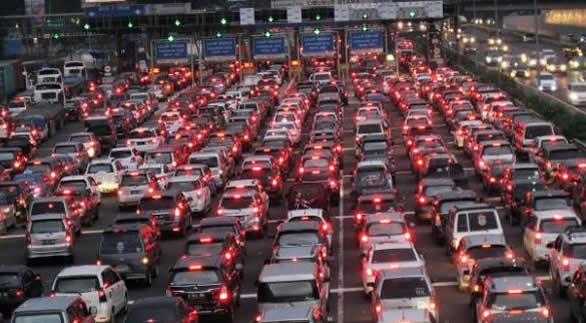
The emission reductions from individual vehicles have not adequately kept pace with the increase in miles driven and the market trend toward more-polluting light trucks, a category that includes sports utility vehicles (SUVs). As a result, cars and light trucks are still the largest single source of air pollution in most urban areas, accounting for one-quarter of emissions of smog-forming pollutants nationwide.

Ingredients of Vehicular Pollution

The following are the major pollutants associated with motor vehicles:
  • Ozone (O3). The primary ingredient in urban smog, ozone is created when hydrocarbons and nitrogen oxides (NOx)—both of which are chemicals released by automobile fuel combustion—react with sunlight. Though beneficial in the upper atmosphere, at the ground level ozone can irritate the respiratory system, causing coughing, choking, and reduced lung capacity.
  • Particulate matter (PM). These particles of soot, metals, and pollen give smog its murky color. Among vehicular pollution, fine particles (those less than one-tenth the diameter of a human hair) pose the most serious threat to human health by penetrating deep into lungs. In addition to direct emissions of fine particles, automobiles release nitrogen oxides, hydrocarbons, and sulfur dioxide, which generate additional fine particles as secondary pollution.
  • Nitrogen oxides (NOx). These vehicular pollutants can cause lung irritation and weaken the body’s defenses against respiratory infections such as pneumonia and influenza. In addition, they assist in the formation of ozone and particulate matter. In many cities, NOx pollution accounts for one-third of the fine particulate pollution in the air.
  • Carbon monoxide (CO). This odorless, colorless gas is formed by the combustion of fossil fuels such as gasoline. Cars and trucks are the source of nearly two-thirds of this pollutant. When inhaled, CO blocks the transport of oxygen to the brain, heart, and other vital organs in the human body. Newborn children and people with chronic illnesses are especially susceptible to the effects of CO.
  • Sulfur dioxide (SO2). Motor vehicles create this pollutant by burning sulfur-containing fuels, especially diesel. It can react in the atmosphere to form fine particles and can pose a health risk to young children and asthmatics.
  • Hazardous air pollutants (toxics). These chemical compounds, which are emitted by cars, trucks, refineries, gas pumps, and related sources, have been linked to birth defects, cancer, and other serious illnesses. The EPA estimates that the air toxics emitted from cars and trucks account for half of all cancers caused by air pollution

Vehicular Emissions That Contribute to Global Warming

Carbon monoxide, ozone, particulate matter, and the other forms of pollution listed above can cause smog and other air quality concerns, but there are vehicular emissions that contribute to a completely different pollution issue: global warming.

The gases that contribute to global warming are related to the chemical composition of the Earth’s atmosphere. Some of the gases in the atmosphere function like the panes of a greenhouse. They let some radiation (heat) in from the sun but do not let it all back out, thereby helping to keep the Earth warm.

The past century has seen a dramatic increase in the atmospheric concentration of heat-trapping gasses, due to human activity. If this trend continues, scientists project that the earth’s average surface temperature will increase between 2.5°F and 10.4°F by the year 2100.

One of these important heat-trapping gasses is carbon dioxide (CO2). Motor vehicles are responsible for almost one-quarter of annual U.S. emissions of CO2. The U.S. transportation sector emits more CO2 than all but three other countries’ emissions from all sources combined.

Curbing Vehicular Pollution
Curbing vehicular pollution

Vehicular emissions that contribute to air quality problems, smog, and global warming can be reduced by putting better pollution-control technologies on cars and trucks, burning less fuel, switching to cleaner fuels, using technologies that reduce or eliminate emissions, and reducing the number of vehiclemiles traveled.

Pollution Control Technology

Federal and California regulations require the use of technologies that have dramatically reduced the amount of smog-forming pollution and carbon monoxide coming from a vehicle’s tailpipe. For gasoline vehicles, “threeway” catalysts, precise engine and fuel controls, and evaporative emission controls have been quite successful. More advanced versions of these technologies are in some cars and can reduce smog-forming emissions from new vehicles by a factor of ten. For diesel vehicles, “two-way” catalysts and engine controls have been able to reduce hydrocarbon and carbon monoxide emissions, but nitrogen oxide and toxic particulate-matter emissions remain very high. More advanced diesel-control technologies are under development, but it is unlikely that they will be able to clean up diesel to the degree already achieved in the cleanest gasoline vehicles.

Added concerns surround the difference between new vehicle emissions and the emissions of a car or truck over a lifetime of actual use. Vehicles with good emission-control technology that is not properly maintained can become “gross polluters” that are responsible for a significant amount of existing air-quality problems. New technologies have also been developed to identify emission-equipment control failures, and can be used to help reduce the “gross polluter” problem.
Rush hour traffic
Rush hour traffic

Burning Less Fuel

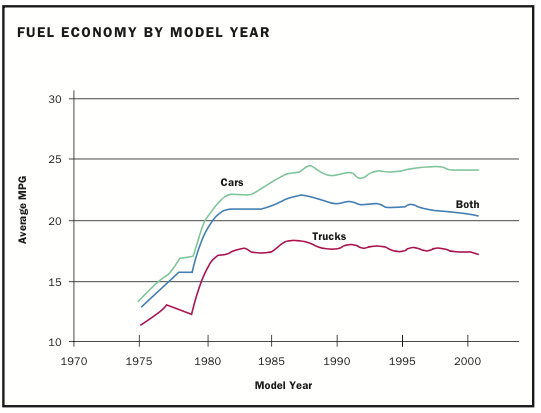
The key to burning less fuel is making cars and trucks more efficient and putting that efficiency to work in improving fuel economy. The U.S. federal government sets a fuel-economy standard for all passenger vehicles. However, these standards have remained mostly constant for the past decade. In addition, sales of lower-fuel-economy light trucks, such as SUVs, pickups, and minivans, have increased dramatically. As a result, on average, the U.S. passenger-vehicle fleet actually travels less distance on a gallon of gas than it did twenty years ago. This has led to an increase in heat-trapping gas emissions from cars and trucks and to an increase in smog-forming and toxic emissions resulting from the production and transportation of gasoline to the fuel pump.

This trend can be reversed through the use of existing technologies that help cars and trucks go farther on a gallon of gasoline. These include more efficient engines and transmissions, improved aerodynamics, better tires, and high strength steel and aluminum.

More advanced technologies, such as hybrid-electric vehicles that use a gasoline engine and an electric motor plus a battery, can cut fuel use even further. These technologies carry with them additional costs, but pay for themselves through savings at the gasoline pump.

Zero-Emission Vehicles

As more cars and trucks are sold and total annual mileage increases, improving pollution-control technology and burning less fuel continues to be vital, especially in rapidly growing urban areas. However, eliminating emissions from the tailpipe goes even further to cut down on harmful air pollutants.

Hydrogen fuel-cell and electric vehicles move away from burning fuel and use electrochemical processes instead to produce the needed energy to drive a car down the road. Fuel-cell vehicles run on electricity that is produced directly from the reaction of hydrogen and oxygen. The only by product is water—which is why fuel-cell cars and trucks are called zero-emission vehicles. Electric vehicles store energy in an onboard battery, emitting nothing from the tailpipe.

The hydrogen for the fuel cell and the electricity for the battery must still be produced somewhere, so there will still be upstream emissions associated with these vehicles. These stationary sources, however, are easier to control and can ultimately be converted to use wind, solar, and other renewable energy sources to come as close as possible to true zero-emission vehicles.

Cleaner Fuels

The gasoline and diesel fuel in use today contains significant amounts of sulfur and other compounds that make it harder for existing control technology to keep vehicles clean. Removing the sulfur from the fuel and cutting down on the amount of light hydrocarbons helps pollution-control technology to work better and cuts down on evaporative and refueling emissions.

Further large-scale reductions of other tailpipe pollution and CO2 can be accomplished with a shift away from conventional fuels. Alternative fuels such as natural gas, methanol, ethanol, and hydrogen can deliver benefits to the environment while helping to move the United States away from its dependence on oil.

All of these fuels inherently burn cleaner than diesel and gasoline, and they have a lower carbon content - resulting in less CO2. Most of these fuels are also more easily made from renewable resources, and fuels such as natural gas and methanol help provide a bridge to producing hydrogen for fuel-cell vehicles.

Transportation of Waste

Transportation of Waste

The transportation of waste is the movement of waste over a specific area by trains, tankers, trucks, barges, or other vehicles. The types of wastes that may be transported range from municipal garbage to radioactive or hazardous wastes.

Hazardous wastes may be transported to be treated, stored, or disposed of. Facilities that generate hazardous waste are required to prepare a shipping document, or “manifest,” to accompany the waste as it is transported from the site of generation. This manifest must accompany the waste until its final destination and is used to track the wastes from cradle-to-grave.

The potential for pollution releases during the transportation of waste varies; the more hazardous the waste and the larger the volume that is transported, the more devastating the environmental/human health impact if an accident occurs. Traffic accidents or train wrecks can result in waste spills and releases of pollutants that may contaminate the air, water, and soil. Wastes may also be released while being loaded or unloaded during transportation.


Approximately four billion tons of regulated hazardous materials are shipped within the United States each year with more 250,000 shipments entering the U.S. transportation system daily. The Emergency Response Notification System (ERNS) database of the Environmental Protection Agency (EPA) shows that from 1988 to 1992 an average of nineteen transportation accidents involving toxic chemicals occurred each day.

DOT Regulations

The U.S. Department of Transportation (DOT) requires that placards identifying the type of hazardous material being transported be placed on the outside of any vehicle transporting hazardous materials or wastes. Placards are used to determine potential hazards in the event of a spill and are placed on all four sides of a vehicle so that HAZMAT teams, fire, emergency, medical, and other personnel who respond to accidents may quickly identify the contents and associated hazards. Placards are required if one thousand pounds or more of a hazardous material is transported and if any amount of material classified as explosive, poisonous, radioactive, or a flammable solid is transported.

The DOT classifies materials based on nine hazard classes represented by symbols. The classes are explosives, gases, flammable liquids, flammable solids, oxidizers, poisonous materials, biohazards, radioactive materials, corrosives, or other regulated materials.

The routes that transporters of hazardous waste use must be carefully considered to minimize the risk of an accidental release. If possible, densely populated areas should be avoided. The type of highway or road and the weather conditions along the route must also be considered. Risk analysis may become important in selecting routes for hazardous waste transport in order to minimize adverse impacts to human health in case of an accidental release.

Municipal Waste

Due to rapidly decreasing space in urban landfills, officials have been forced to find alternate locations for municipal waste disposal. This has created significant financial incentives for rural communities to accept garbage from urban areas. Depending on the location of these rural facilities, it may be necessary to transport large quantities of wastes by a variety of methods, most often by truck, railway, or barge.

Many citizens are concerned about the transportation of the waste through their communities and the risks involved. People are also concerned that the municipal waste from urban areas may be contaminated with toxic chemicals or substances that could contaminate local drinking water supplies.

Disposal of hazardous wastes in the United States can cost up to $2,500 per ton. This has led to the practice of selling waste to developing countries for disposal at a much lower cost. This international waste trade may be illegal in some instances, but the hefty sum paid to those who accept the wastes remains tempting to developing countries.

However, the actual composition of the wastes received by developing countries is often misrepresented by those selling the waste. In addition, most developing countries lack the resources and technical expertise to safely manage these hazardous wastes.

Transporting hazardous wastes

Trade in hazardous wastes is a global issue. About ten percent of all hazardous wastes generated around the world cross international boundaries. A large portion goes from industrialized countries to developing countries where disposal costs are lower.

Although developing countries may lack the financial and technical capacities to clean up hazardous waste releases in their countries, these countries nevertheless are sites for treatment, recycling, and disposal of wastes from abroad.

The Basel Convention on the Control of the Transboundary Movement of Hazardous Wastes and Their Disposal is the first global environmental treaty to control the international trade of waste. Under the Convention, trade in hazardous wastes cannot take place without the consent of the importing country and cannot occur under conditions that are assessed as not environmentally sound.

As of April 2002, 150 countries had ratified the convention. A new protocol adopted by the convention in 2000 provides the first international framework establishing liability for damages that may result from the transportation or disposal of hazardous wastes across foreign borders

Waste Reduction

Waste reduction
Waste reduction

Waste reduction, also known as source reduction, is the practice of using less material and energy to minimize waste generation and preserve natural resources. Waste reduction is broader in scope than recycling and incorporates ways to prevent materials from ending up as waste before they reach the recycling stage. Waste reduction includes reusing products such as plastic and glass containers, purchasing more durable products, and using reusable products, such as dishrags instead of paper towels.

Donating products, from office equipment to eyeglasses and clothing, reduces the amount of material manufactured overall. Purchasing products that replace hazardous materials with biodegradable ingredients reduces pollution as well as waste.

In general, waste reduction offers several environmental benefits. Greater efficiency in the production and use of products means less energy consumption, resulting in less pollution. More natural resources are preserved. Products using less hazardous materials are used. Finally, less solid waste ends up in landfills.


Waste reduction also means economic savings. Fewer materials and less energy is used when waste-reduction practices are applied. Rather than using the traditional cradle-to-grave approach, a cradle-to-cradle system is adopted. In this cradle-to-cradle system, also called industrial ecology, products are not used for a finite length of time. Instead of disposing of materials, or the components of a product after a single use, products are passed on for further uses. This is considered a flow of materials.

This can be applied within an organization, or between organizations that may be considered unrelated, on a cooperative basis. For example, a cotton manufacturer sends its unwanted scraps to an upholsterer, who uses the scraps as stuffing in chairs. When the life span of the chair is reached, the materials are returned to the manufacturer, who reuses the parts with endurance.

The damaged upholstery, which was originally created using nonhazardous materials, is sold to a local farmer who uses it in composting. Money is also saved through reduced purchasing. Waste-disposal costs are decreased because fewer materials end up as waste.

Reduce food waste
Reduce food waste

Waste can be reduced by individuals, businesses, institutions such as hospitals or educational facilities, organizations, municipalities, or government agencies. There are several ways individuals can practice waste reduction:
  1. Reusing products. This could mean reusing file folders rather than throwing them away after one use, or refilling water bottles; 
  2. Using products more efficiently. This could mean using both sides of paper in photocopying; and 
  3. Donating or exchanging products or materials that may seem useless, but that another party may find valuable. For example, the chair manufacturer mentioned above had no internal use for the scrap upholstery leftover after recycling the more durable parts of the used chairs. However, a cooperative agreement with a local farmer allowed the scraps to be used once again, benefiting the farmer by adding to his compost.

The EPA’s WasteWise Program

The Environmental Protection Agency (EPA) lists waste reduction and reuse as top priorities in its solid waste management hierarchy, followed by recycling, composting, waste-to-energy, and landfilling. Many governments and businesses have adopted the practice of waste reduction.

The EPA offers a free, comprehensive waste-reduction program to businesses, organizations, and municipalities. The program, called WasteWise, offers educational and technical assistance in developing, executing, and measuring waste-reduction activities. Through WasteWise, groups can design and maintain a waste-reduction program that is flexible to their specific needs. The nationwide program was started in 1994, and it had over eleven hundred participating partners in 2002.

Large corporations, universities, and cities across the country have seen significant benefits, both economically and environmentally, by using WasteWise.

The National Recycling Coalition Recommendations

The National Recycling Coalition lists several steps that purchasing departments of organizations can use in their waste-reduction strategies:
  1. Reduce product use. Adopt the practice of printing on both sides of office paper.
  2. Rent or lease products or equipment. This includes leasing, rather than purchasing, equipment such as photocopiers, which can become obsolete, leaving the organization with old, unnecessary, and sometimes hazdardous equipment to discard.
  3. Purchase remanufactured or rebuilt products, or products that can be refurbished.
  4. Purchase more durable products. Higher-quality products typically have a longer life cycle.
  5. Purchase products that use nonhazardous materials. Nonhazardous materials are safer for individuals and landfills.
  6. Purchase returnable, reusable, or refillable products. For instance, transport containers can be reused.
  7. Purchase products in bulk.
  8. Purchase products that reuse packaging or use less packaging.
  9. Share and reuse resources within the organization. Companies can implement an internal computer equipment and office supply exchange before purchasing new products.

The EPA reports that 232 million pounds of waste were generated in 2000. The amount of waste produced per person has grown over the last thirty-five years, from 2.7 to 4.6 pounds per day. In 1999, waste reduction saved over fifty million tons of municipal solid waste from being dumped into landfills.

Waste to Energy

Pile of waste ready to process

Waste to energy (WTE) is the term used to describe the conversion of waste by-products into useful steam or steam-generated electricity. Typically, WTE is produced by converting municipal solid waste (MSW), which is defined as residential and commercial refuse, and makes up the largest source of waste in industrialized countries.

This industry has been producing heat and power in the United States for a century, and there are currently more than one hundred WTE plants nationwide. Recently, however, the definition of waste has been expanded from MSW to include wastes such as wood, wood waste, peat, wood sludge, agricultural waste, straw, tires, landfill gases, fish oils, paper industry liquors, railroad ties, and utility poles.

In 1999 these by-products produced approximately 3.2 quadrillion BTUs (i.e., 1 × 10^15) British thermal units, which is also known as a quad) of energy out of approximately 97.0 quads of energy consumed in the United States.


Nearly thirty million tons of trash are processed each year in WTE facilities to generate steam and electricity. The benefits to society include the following: preventing the release of greenhouse gases such as methane into the atmosphere if the trash were landfilled; reducing the impact on landfills by reducing the volume of the waste 80 to 90 percent; providing an alternative to coal use, which prevents the release of emissions such as nitrogen oxides into the atmosphere; and saving the earth’s natural resources by using less oil, coal, or natural gas for electricity generation.

The Process of Converting Waste to Energy

Generally, WTE facilities can be divided into two process types: mass burn and refuse-derived fuel (RDF). Mass burn facilities process raw waste that has not been shredded, sized, or separated before combustion, although large items such as appliances and hazardous waste materials and batteries are removed before combustion.

In mass burn systems, untreated MSW is simply burned, with the heat produced converted into steam, which can then be passed through a steam turbine to generate electricity or used directly to supply heat to nearby industries or buildings.

Waste to energy plant diagram

RDF is a result of processing MSW to separate the combustible fraction from the noncombustibles, such as metals and glass. RDF is mainly composed of paper, plastic, wood, and kitchen or yard wastes, and has a higher energy content than untreated MSW. Like MSW, RDF is then burned to produce steam and/or electricity.

A benefit of using RDF is that it can be shredded into uniformly sized particles or compressed into briquettes, both of which facilitate handling, transportation, and combustion. Another benefit of RDF rather than raw MSW is that fewer noncombustibles such as heavy metals are burned.

Energy Production from Waste in the United States and South America

South America, with its agrarian societies, surprisingly consumes very few wastes for the production of steam or electricity. Brazil is the largest country in South America and is also the largest energy consumer, consuming about 8.5 quads of energy each year as compared to 6.1 quads for Mexico, 12.5 quads for Canada, and 97.0 quads for the United States.

Converting waste into energy

Due to the large size of Brazil’s agricultural sector, biomass is seen as the best future alternative energy source. Currently, Brazil produces about 4,000 gigawatt (1 × 10^9) hours annually (i.e., 0.1 quads equivalent) in the sugar industry to run its own refineries and distilleries.

At the same time, Brazil produces up to 3.9 billion gallons of ethanol (i.e., 0.5 quads equivalent) for automobiles each year, although it is manufactured from sugar and not waste materials. No other South American countries produce significant quantities of energy from waste; however, Argentina’s biomass energy use, like Brazil’s, is expected to grow in the coming years.

In the United States, corn is the primary feedstock along with barley and wheat that is currently being used to produce ethanol, although neither corn or grains are considered wastes. Considerable ongoing research is exploring the use of true biomass wastes such as corn stover or wood chips and sawdust for ethanol production. One project at the U.S. Department of Energy involves the cofiring of sawdust and tires with coal in utility boilers.

Domestic Wastewater Treatment


Wastewater is treated to remove pollutants (contaminants). Wastewater treatment is a process to improve and purify the water, removing some or all of the contaminants, making it fit for reuse or discharge back to the environment. Discharge may be to surface water, such as rivers or the ocean, or to groundwater that lies beneath the land surface of the earth. Properly treating wastewater assures that acceptable overall water quality is maintained.

In many parts of the world health problems and diseases have often been caused by discharging untreated or inadequately treated wastewater. Such discharges are called water pollution, and result in the spreading of disease, fish kills, and destruction of other forms of aquatic life. The pollution of water has a serious impact on all living creatures, and can negatively affect the use of water for drinking, household needs, recreation, fishing, transportation, and commerce.

Objectives and Evolution of Wastewater Treatment

We cannot allow wastewater to be disposed of in a manner dangerous to human health and lesser life forms or damaging to the natural environment. Our planet has the remarkable ability to heal itself, but there is a limit to what it can do, and we must make it our goal to always stay within safe bounds. That limit is not always clear to scientists, and we must always take the safe approach to avoid it.

Basic wastewater treatment facilities reduce organic and suspended solids to limit pollution to the environment. Advancement in needs and technology have necessitated the evolving of treatment processes that remove dissolved matter and toxic substances. Currently, the advancement of scientific knowledge and moral awareness has led to a reduction of discharges through pollution prevention and recycling, with the noble goal of zero discharge of pollutants.

Treatment technology includes physical, biological, and chemical methods. Residual substances removed or created by treatment processes must be dealt with and reused or disposed of in a safe way. The purified water is discharged to surface water or ground water. Residuals, called sludges or biosolids, may be reused by carefully controlled composting or land application. Sometimes they are incinerated.

Since early in history, people have dumped sewage into waterways, relying on natural purification by dilution and by natural bacterial breakdown. Population increases resulted in greater volume of domestic and industrial wastewater, requiring that we give nature a helping hand. Some so-called advancements in cities such as Boston involved collecting sewage in tanks and releasing it to the ocean only on the outgoing tide. Sludge was barged out to sea so as to not cause complaint.

Until the early 1970s, in the United States, treatment mostly consisted of removal of suspended and floating material, treatment of biodegradable organics, and elimination of pathogenic organisms by disinfection. Standards were not uniformly applied throughout the country.

In the early 1970s until about 1980, aesthetic and environmental concerns were considered. Treatment was at a higher level, and nutrients such as nitrogen and phosphorus were removed in many localities.

Since 1980, focus on health concerns related to toxics has driven the development of new treatment technology. Water-quality standards were established by states and the federal government and had to be met as treatment objectives. Not just direct human health but aquatic-life parameters were considered in developing the standards.

Wastewater Treatment Types

Rural unsewered areas, for the most part, use septic systems. In these, a large tank, known as the septic tank, settles out and stores solids, which are partially decomposed by naturally occurring anaerobic bacteria. The solids have to be pumped out and hauled by tank truck to be disposed of separately. They often go to municipal wastewater treatment plants, or are reused as fertilizer in closely regulated land-application programs. Liquid wastes are dispersed through perforated pipes into soil fields around the septic tank.

Most urban areas with sewers first used a process called primary treatment, which was later upgraded to secondary treatment. Some areas, where needed, employ advanced or tertiary treatment. Common treatment schemes are presented in the following paragraphs.

Primary Treatment. 

In primary treatment, floating and suspended solids are settled and removed from sewage. Flow from the sewers enters a screen/bar rack to remove large, floating material such as rags and sticks.

It then flows through a grit chamber where heavier inorganics such as sand and small stones are removed.

Grit removal is usually followed by a sedimentation tank/clarifiers where inorganic and organic suspended solids are settled out.

To kill pathogenic bacteria, the final effluent from the treatment process is disinfected prior to discharge to a receiving water. Chlorine, in the form of a sodium hypochlorite solution, is normally used for disinfection. Since more chlorine is needed to provide adequate bacteria kills than would be safe for aquatic life in the stream, excess chlorine is removed by dechlorination. Alternate disinfection methods, such as ozone or ultraviolet light, are utilized by some treatment plants.

Sludge that settles to the bottom of the clarifier is pumped out and dewatered for use as fertilizer, disposed of in a landfill, or incinerated. Sludge that is free of heavy metals and other toxic contaminants is called Biosolids and can be safely and beneficially recycled as fertilizer, for example.

Secondary Treatment

Primary treatment provided a good start, but, with the exception of some ocean outfalls, it is inadequate to protect water quality as required by the Environmental Protection Agency (EPA).

With secondary treatment, the bacteria in sewage is used to further purify the sewage. Secondary treatment, a biological process, removes 85 percent or more of the organic matter in sewage compared with primary treatment, which removes about 50 percent.

The basic processes are variations of what is called the “activated sludge” process or “trickling filters,” which provide a mechanism for bacteria, with air added for oxygen, to come in contact with the wastewater to purify it.

In the activated sludge process, flow from the sewer or primary clarifiers goes into an aeration tank, where compressed air is mixed with sludge that is recycled from secondary clarifiers which follow the aeration tanks. The recycled, or activated, sludge provides bacteria to consume the “food” provided by the new wastewater in the aeration tank, thus purifying it.

In a trickling filter the flow trickles over a bed of stones or synthetic media on which the purifying organisms grow and contact the wastewater, removing contaminants in the process. The flow, along with excess organisms that build up on the stones or media during the purification, then goes to a secondary clarifier.

Air flows up through the media in the filters, to provide necessary oxygen for the bacteria organisms. Clarified effluent flows to the receiving water, typically a river or bog, after disinfection. Excess sludge is produced by the process and after collection from the bottom of the secondary clarifiers it is dewatered, sometimes after mixing with primary sludge, for use as fertilizer, disposed of in a landfill, or incinerated.

Advanced or Tertiary Treatment

As science advanced the knowledge of aquatic life mechanisms and human health effects, and the need for purerwater was identified, technology developed to provide better treatment. Heavy metals, toxic chemicals and other pollutants can be removed from domestic and industrial wastewater to an increasing degree. Methods of advanced treatment include microfiltration, carbon adsorption, evaporation /distillation, and chemical precipitation.

Marine Pollution

Marine Pollution
Marine Pollution

Marine pollution is the release of by-products of human activity that cause harm to natural marine ecosystems. The pollutants may be sewage, farm waste, toxic chemicals, or inert materials that may smother, choke, or strangle living organisms.

Sewage, Animal Waste, and Fertilizers

Sewage, animal waste, and chemical fertilizers all have a high content of nitrogen and phosphorus. Artificially high levels of these substances in the water promote excessive growth of microscopic or macroscopic plants, in a process called eutrophication. When these plants accumulate, die, and decay, they cause low oxygen content in the water. Even if sewage is treated to remove solids, the liquid discharged contains high levels of nitrogen and phosphorus.

Intensive cultivation of animals in feedlots, or application of more fertilizer than a crop can absorb, also cause runoff rich in nitrogen and phosphorus that find their way into rivers and estuaries. Vehicle exhausts and industrial chimneys are large sources of nitrogen compounds that are transported in the atmosphere and deposited in coastal waters.


On a global scale, agricultural runoff is the most important source of eutrophication, but atmospheric deposition is the fastest-growing source. It is the largest source of nitrogen off the coast of the northeastern United States, in the western Baltic Sea, and in the western Mediterranean Sea. International agencies consider that, worldwide, eutrophication is the most serious pollution problem in coastal waters.

For example, in the Gulf of Mexico, off the mouth of the Mississippi River, water near the bottom has severely reduced oxygen content over a very large area, sixteen thousand square kilometers (6,200 square miles) by 1998. Mobile animals such as fish and shrimp leave the hypoxic area, but sedentary animals such as clams and worms are killed in large numbers.

A classic example of eutrophication and its treatment occurred in the estuary of the River Thames, near London, England. In the 1950s the water was severely hypoxic for thirty-five kilometers (twenty-two miles) below London Bridge. After several sewage treatment plants were built, the water returned to a well-oxygenated state and migratory fish such as salmon once again ascend the river.

Troubled turtle
Troubled turtle

In the case of the Mississippi River, treatment of the eutrophication is more difficult because runoff from agricultural land is the major cause of the problem, and more than half of the agricultural land in the United States drains into the Mississippi basin. Cleaning up the pollution would involve changes in farming methods on a national scale.

Eutrophication has important indirect effects. The plants known as sea grasses, which grow in the shallow water of estuaries, provide food and shelter for a wide range of animals, including geese, turtles, manatees, and fish. In eutrophicated water, the dense microscopic plant life significantly reduces the penetration of light and smothers the sea grasses.

In Chesapeake Bay, Maryland, eutrophication caused an area of sea grasses to decrease by two-thirds between 1960 and 1980, and there was a corresponding decrease in landings of fish and crabs. Similar effects have been observed in Australia.

Sea grass loss because of eutrophication
Sea grasses loss because of eutrophication

Red tides, or harmful algal blooms, are associated with eutrophication. Single species of phytoplankton multiply at the expense of all other species and become so abundant that the water is discolored. Many bloom species produce toxic substances. During the 1990s in estuaries located in the south-eastern United States, there were numerous cases of blooms of Pfiesteria piscida, a dinoflagellate that produced a toxin which killed thousands of fish.

The source of the nutrients support Pfiesteria is believed to be agricultural runoff or sewage discharge. Other types of blooms are ingested by shellfish, which become toxic for humans who consume them, causing partial paralysis, memory loss, or even death. Toxic blooms have been reported much more frequently in the 1990s than in the past, and the spread of eutrophication is believed to be a contributing factor.

Pollution and Coral Reefs

On coral reefs, eutrophication causes seaweed to grow and smother the corals. Several kinds of environmental problems interact with eutrophication to cause the deterioration of coral reefs. Overharvesting of the fish and invertebrates that eat seaweed accelerates the smothering.

Careless development along coastlines and in river basins leads to soil erosion and the transport of heavy loads of silt and clay, which settle on the corals and smother them. Oil spills also take their toll. When corals are exposed to abnormally high water temperature, they respond by discharging the microscopic algae living within their tissues. Sometimes they recover, but often they die.

These episodes, called coral bleaching, became much more frequent during the 1990s and are believed to be caused by global warming. The result of pollution and global warming is that at least half of the area of coral reefs in south-east Asia is in poor condition, and in parts of the Caribbean Sea only 5 percent of the reef area consists of living coral.

Metals and Organic Contaminants

Industrial effluents often contain metallic compounds. For example, Halifax, a small city in eastern Canada, discharged into its harbor during the 1990s about thirty-three tons of zinc and thirty-one tons of lead per year, with lesser amounts of copper and other metals. These metals are held in the sediment in a relatively inert form, but if stirred up into the water column, they become oxygenated and toxic.

Tin is another common pollutant in harbors. It occurs as tributyltin (TBT), which is used as a component of antifouling paints on the undersides of ships. When taken up by shellfish, it accumulates in their tissues and has proved toxic to the shellfish and to organisms that consume them. The United States began to phase out TBT in 1988, and it will be banned internationally beginning in 2008.

Industry also produces organic compounds such as polychlorinated biphenyls (PCBs) and various pesticides. These accumulate in the fatty tissue of plants and animals low in the food chain, and as they pass through the food web to larger and long-lived animals, there is an increase in concentration of the substances in their fat, a process known as bioaccumulation. The St. Lawrence River, which drains the Great Lakes, has accumulated large amounts of organochlorines, which have amassed in the tissues of Beluga whales.

During the 1990s, the level of this pollution was much reduced, and the whales have been protected from hunting, but their population fails to increase. Many animals have tumors and disease. There is mounting evidence that chronic exposure to contaminants causes suppression of the immune responses of marine mammals. Similar problems have occurred with seals in the Baltic Sea.

Marine Debris

Marine debris
Marine debris

Marine beaches serve as natural traps for marine debris. Globally, the most common materials are plastics, followed by glass and metal. The chief dangers to marine life result from the ingestion of these fragments, which may block the gut, and from entangling, which may cause suffocation or prevent locomotion and feeding.

In a survey of U.S. beaches close to urban centers, cigarette butts were the most abundant debris, followed by packaging items (boxes, bags, caps, lids), medical waste, and sewage. A high proportion of this material reached the sea by way of sewers. Even street litter can be washed into surface drains and then to the sea. The dumping of sewage and waste by ships is another source.

Public revulsion at the state of U.S. beaches was a key factor in the enactment of stronger environmental protection laws, like the Ocean Dumping Ban Act of 1988 that prohibited the dumping of sewage into the ocean. On sites more remote from cities, pieces of rope and netting are the most common types of marine debris.

Turtle, leatherback sea

Description and biology

The leatherback is the largest sea turtle in the world. An average adult can measure up to 5 feet (1.5 meters) long and weigh between 800 and 1,000 pounds (363 and 454 kilograms). Other marine turtles have hard, bony–plated shells, or carapaces (pronounced KAR–a–paces).

The dark brown to black carapace of the leatherback sea turtle is made of seven raised ridges that are soft and rubbery. Its front flippers are exceptionally long and powerful. When extended, they may span over 8 feet (2.4 meters). The turtle’s head and neck are dark brown or black with white or yellowish blotches.