Description and biology
The Galápagos giant tortoise is a gigantic tortoise that can weigh up to 580 pounds (263 kilograms). In certain subspecies, its top shell, or carapace (pronounced KAR–a–pace), is high and shaped like a dome. In others, the carapace is high only in front.
This low–lying shell—called saddleback—flares out at the bottom. The length of a Galápagos giant tortoise varies depending on the shape of its carapace and its gender. An average saddleback female measures 24 inches (61 centimeters) long, while an average domed–shelled male measures about 50 inches (127 centimeters) long.
Galápagos giant tortoises reach sexual maturity between 20 and 30 years of age. Breeding usually takes places between January and June, the rainy season. After mating, a female Galápagos giant tortoise migrates to an arid (dry), lowland area to lay her eggs.
Beginning in June, she lays between 2 and 20 tennis–ball–shaped eggs in a nest she has dug out in the ground. She then covers the nest and returns to the highlands. The eggs incubate (develop) for four to eight months before hatching.
The nest’s temperature determines the offspring’s sex: warmer temperatures produce more females; cooler temperatures produce more males. Between November and April, the eggs hatch and the young tortoises begin to dig their way out of the nest. At birth, they weigh about 9 ounces (255 grams), or 0.1 percent of their adult weight.
The Galápagos giant tortoise, which may live to be 100 years old, is an herbivore (plant–eater). It feeds on more than 50 different types of plants. The tortoise has a keen sense smell, and it will smell all of its food before eating. It can survive for a long period without food or water because it can metabolize, or break down, fat stored in its tissues.
Habitat and current distribution
The Galápagos giant tortoise is found only on the Galápagos Islands, a province of Ecuador lying about 600 miles (965 kilometers) off the country’s west coast. It inhabits the islands of Hood, Isabela, Pinzon, San Cristobal, Santa Cruz, and Santiago. Biologists (people who study living organisms) estimate that about 15,000 Galápagos giant tortoises currently exist.
This tortoise is found in various areas on these islands, from sea level to the highest points. During the dry season, the tortoise migrates to higher altitudes to find food and water. Most larger Galápagos giant tortoises are found in the higher altitudes.
History and conservation measures
Humans have been a major threat to the Galápagos giant tortoise. When Spanish navigator Tomás de Bertanga and his fellow explorers discovered the Galápagos Islands in 1535, they found so many giant tortoises there that they named the islands Galápagos, Spanish for “tortoise.” Biologists estimate that 250,000 tortoises inhabited the islands when Bertanga and his men arrived.
In the nineteenth century, whalers and explorers who visited the islands slaughtered thousands of Galápagos giant tortoises for their meat, oil, and fat. To have fresh meat during their voyages, these men sometimes took live tortoises on board their ships and stored them in the holds for up to a year before killing them.
The Galápagos giant tortoise is currently threatened by animals introduced by humans into the tortoise’s habitat. Dogs and pigs prey on tortoise eggs and young tortoises. Goats compete with the tortoises for food. Donkeys trample or roll in tortoise nesting areas, often damaging eggs.
In 1959, the Ecuadoran government declared all uninhabited areas of the Galápagos Islands to be a national park. This act prevents any island species from being hunted, captured, or disturbed.
The Charles Darwin Research Station on Santa Cruz Island has launched a program to control the predator population. Although this program has been successful, the outlook for the survival of the Galápagos giant tortoise remains guarded.
Tuatara
Description and biology
The tuatara (pronounced too–a–TAR–a) is a lizardlike reptile. It is olive green and speckled with yellow. It has a medium–sized head and a strong tail. The tuatara’s feet and hands each have five clawed digits (toelike projections). A crest of soft spines stretches along its back to the base of its tail.
An average female tuatara measures 20 inches (51 centimeters) long and weighs about 1 pound (0.45 kilogram). An average male measures 24 inches (61 centimeters) in length and weighs about 2.6 pounds (1.2 kilograms).
The tuatara has certain physical characteristics that separate it from lizards. Among other things, it has extra holes in its skull and bony projections on its ribs. Males of the species lack a copulating (breeding) organ.
It has a single row of teeth in its lower jaw and a double row in its upper jaw. When the tuatara’s mouth is closed, its bottom row of teeth fit neatly between its upper two rows. None of these teeth are replaced when worn out or damaged. This reptile also has a third eye—called a pineal eye—on the top of its head.
The eye contains a simplistic lens and retina and is connected to the brain by a nerve. Since this eye is covered by opaque scales, not much light gets through. Some biologists (people who study living organisms) believe the eye may function as a light sensor, determining how much time the tuatara spends basking in sunlight.
The tuatara is mainly nocturnal (active at night). It feeds on worms, snails, beetles, crickets, birds’ eggs, small lizards, and frogs. During the day, when not basking in the sun, the tuatara spends time in burrows built as nests by shearwaters and petrels (both sea birds).
Since males do not have copulating organs, tuataras breed like birds. When mating, a male and female bring their cloacae into contact. A cloaca (pronounced klow–AH–ka) is a cavity in the body of birds, reptiles, amphibians, and most fishes that has an opening to the outside through which sperm and body wastes such as feces pass.
Once having mated, a female tuatara lays a clutch of 6 to 10 eggs in a burrow or tunnel sometime between October and December. The female abandons the eggs after covering them with soil and the eggs hatch 13 to 15 months later. Tuataras can live up to 100 years. Habitat and current distribution
The tuatara is found on about 30 islands around New Zealand. Biologists estimate that the current tuatara population is between 60,000 and 100,000. More than half of all tuataras exist on Stephens Island.
On its island habitat, the tuataras is found in forest or dense scrub areas from sea level to an altitude 1,000 feet (305 meters) above sea level.
History and conservation measures
Tuataras are the most ancient of all living reptiles. They are the last surviving members of a family of reptiles that stretches back to the early Mesozoic Era, about 200,000,000 years ago.
During the age of reptiles, tuataras lived alongside dinosaurs. With the extinction of the dinosaurs 65,000,000 years ago, the age of mammals began and the tuatara soon disappeared from everywhere on Earth except New Zealand.
Humans first came to the New Zealand islands from nearby Polynesian islands sometime between 1,000 and 2,000 years ago. They brought with them the kiore, or Polynesian rat.
The kiore quickly became a predator of tuatara eggs and young. As more humans came to the New Zealand islands, bringing with them predators such as pigs and cats, the tuatara suffered. By the end of the nineteenth century, the reptile had become extinct on the main islands of New Zealand.
Efforts are currently underway to remove rats from tuatara island habitats. On the island of Tiritiri Matangi, all rats have now been eliminated. The island now teems with rich plant life, insects, lizards, forest birds, and tuataras. All islands on which tuataras are found are designated either wildlife sanctuaries or flora and fauna reserves. Both of these designations limit the number of humans who can visit these islands.
The tuatara (pronounced too–a–TAR–a) is a lizardlike reptile. It is olive green and speckled with yellow. It has a medium–sized head and a strong tail. The tuatara’s feet and hands each have five clawed digits (toelike projections). A crest of soft spines stretches along its back to the base of its tail.
An average female tuatara measures 20 inches (51 centimeters) long and weighs about 1 pound (0.45 kilogram). An average male measures 24 inches (61 centimeters) in length and weighs about 2.6 pounds (1.2 kilograms).
The tuatara has certain physical characteristics that separate it from lizards. Among other things, it has extra holes in its skull and bony projections on its ribs. Males of the species lack a copulating (breeding) organ.
It has a single row of teeth in its lower jaw and a double row in its upper jaw. When the tuatara’s mouth is closed, its bottom row of teeth fit neatly between its upper two rows. None of these teeth are replaced when worn out or damaged. This reptile also has a third eye—called a pineal eye—on the top of its head.
The eye contains a simplistic lens and retina and is connected to the brain by a nerve. Since this eye is covered by opaque scales, not much light gets through. Some biologists (people who study living organisms) believe the eye may function as a light sensor, determining how much time the tuatara spends basking in sunlight.
The tuatara is mainly nocturnal (active at night). It feeds on worms, snails, beetles, crickets, birds’ eggs, small lizards, and frogs. During the day, when not basking in the sun, the tuatara spends time in burrows built as nests by shearwaters and petrels (both sea birds).
Since males do not have copulating organs, tuataras breed like birds. When mating, a male and female bring their cloacae into contact. A cloaca (pronounced klow–AH–ka) is a cavity in the body of birds, reptiles, amphibians, and most fishes that has an opening to the outside through which sperm and body wastes such as feces pass.
Once having mated, a female tuatara lays a clutch of 6 to 10 eggs in a burrow or tunnel sometime between October and December. The female abandons the eggs after covering them with soil and the eggs hatch 13 to 15 months later. Tuataras can live up to 100 years. Habitat and current distribution
The tuatara is found on about 30 islands around New Zealand. Biologists estimate that the current tuatara population is between 60,000 and 100,000. More than half of all tuataras exist on Stephens Island.
On its island habitat, the tuataras is found in forest or dense scrub areas from sea level to an altitude 1,000 feet (305 meters) above sea level.
History and conservation measures
Tuataras are the most ancient of all living reptiles. They are the last surviving members of a family of reptiles that stretches back to the early Mesozoic Era, about 200,000,000 years ago.
During the age of reptiles, tuataras lived alongside dinosaurs. With the extinction of the dinosaurs 65,000,000 years ago, the age of mammals began and the tuatara soon disappeared from everywhere on Earth except New Zealand.
Humans first came to the New Zealand islands from nearby Polynesian islands sometime between 1,000 and 2,000 years ago. They brought with them the kiore, or Polynesian rat.
The kiore quickly became a predator of tuatara eggs and young. As more humans came to the New Zealand islands, bringing with them predators such as pigs and cats, the tuatara suffered. By the end of the nineteenth century, the reptile had become extinct on the main islands of New Zealand.
Efforts are currently underway to remove rats from tuatara island habitats. On the island of Tiritiri Matangi, all rats have now been eliminated. The island now teems with rich plant life, insects, lizards, forest birds, and tuataras. All islands on which tuataras are found are designated either wildlife sanctuaries or flora and fauna reserves. Both of these designations limit the number of humans who can visit these islands.
Green Sea Turtle
Description and biology
The green sea turtle is the largest of the hard–shelled sea turtles. An average adult weighs 300 to 350 pounds (136 to 159 kilograms) and has an upper shell, or carapace (pronounced KAR–a–pace), length of about 40 inches (102 centimeters).
The large, heart–shaped carapace varies in color from dark greenish–brown to olive brown. The turtle’s head is small and its front legs are large and flipper–shaped. It feeds mainly on sea grasses and algae.
Green sea turtles build nests on beaches at various times during the year depending on their location. Mating usually occurs in the water within 0.5 mile (0.8 kilometer) of the nesting beach.
After mating, the female crawls slowly up on the beach at night, being very sensitive to light, sound, and other disturbances. Using her rear flippers to dig a hole, she lays her eggs, buries them with sand, then returns to the ocean.
The average clutch (eggs produced at one time) size is 110 eggs, and a female may lay between 3 and 7 clutches a season. The eggs incubate (develop) for a period of 52 to 61 days. Upon hatching, the young turtles race for the water, but are often preyed on by birds. In the water, they are preyed on by fish.
Habitat and current distribution
The green sea turtle ranges widely, having been observed as far south as Polla Island, Chile, and as far north as the English Channel. However, it is mainly a pantropical species, meaning it nests in tropical and subtropical regions.
Biologists (people who study living organisms) believe there are about 150 nesting sites worldwide. Only about 10 to 15 of these sites support large populations (2,000 or more nesting females per year).
The largest sites are found on Ascension Island in the southern Atlantic, western Australia, Costa Rica, Europa and Tromelin Islands in the Mozambique Channel (strait between Madagascar and Mozambique), the Pacific coast of Mexico, the northeast coast of Oman, Pakistan, and Florida.
Because males do not leave the water, biologists have found it difficult to obtain accurate population totals for the green sea turtle. Some sources list the turtles’ world population at 500,000.
The breeding populations along the Pacific coast of Mexico and in Florida are the ones considered endangered. Biologists estimate that only about 300 to 400 adult females nest in Florida.
History and conservation measures
Green sea turtles have been declining in number for hundreds of years. They have always been hunted for food. In modern times, this hunting has risen with advancements in fishing technology and increases in human populations in tropical areas.
Turtle eggs are collected for food; young turtles are hunted and then stuffed for souvenirs; and adults are hunted for their meat (for food), for their skins (for leather goods), and for their oil (for cosmetics).
Like other sea turtles, the green sea turtle faces the threat of nesting habitat loss. Beachfront development has decreased suitable nesting habitat for the turtle throughout its range. Even development near nesting beaches has hurt the turtle: increased shoreside lighting interferes with a female’s ability to lay eggs.
Green sea turtles are often caught in shrimp nets and drown. A device called a turtle excluder device, or TED, is often used to prevent these unwanted trappings.
The TED, an open–ended grid of bars, is fitted in the neck of a shrimp net. It allows small sea animals like shrimp to pass through into the bag end of the net, but prevents larger sea animals like turtles from entering.
The larger animals are ejected back into open water. Although TEDs are successful in saving large sea animals, fishermen do not like to use them because they believe the TEDs limit the amount of shrimp they catch.
Because green sea turtles range across such a wide area, international cooperation is needed to conserve the species and its habitat. Agreements on how best to do that have not yet been reached.
The green sea turtle is the largest of the hard–shelled sea turtles. An average adult weighs 300 to 350 pounds (136 to 159 kilograms) and has an upper shell, or carapace (pronounced KAR–a–pace), length of about 40 inches (102 centimeters).
The large, heart–shaped carapace varies in color from dark greenish–brown to olive brown. The turtle’s head is small and its front legs are large and flipper–shaped. It feeds mainly on sea grasses and algae.
Green sea turtles build nests on beaches at various times during the year depending on their location. Mating usually occurs in the water within 0.5 mile (0.8 kilometer) of the nesting beach.
After mating, the female crawls slowly up on the beach at night, being very sensitive to light, sound, and other disturbances. Using her rear flippers to dig a hole, she lays her eggs, buries them with sand, then returns to the ocean.
The average clutch (eggs produced at one time) size is 110 eggs, and a female may lay between 3 and 7 clutches a season. The eggs incubate (develop) for a period of 52 to 61 days. Upon hatching, the young turtles race for the water, but are often preyed on by birds. In the water, they are preyed on by fish.
Habitat and current distribution
The green sea turtle ranges widely, having been observed as far south as Polla Island, Chile, and as far north as the English Channel. However, it is mainly a pantropical species, meaning it nests in tropical and subtropical regions.
Biologists (people who study living organisms) believe there are about 150 nesting sites worldwide. Only about 10 to 15 of these sites support large populations (2,000 or more nesting females per year).
The largest sites are found on Ascension Island in the southern Atlantic, western Australia, Costa Rica, Europa and Tromelin Islands in the Mozambique Channel (strait between Madagascar and Mozambique), the Pacific coast of Mexico, the northeast coast of Oman, Pakistan, and Florida.
Because males do not leave the water, biologists have found it difficult to obtain accurate population totals for the green sea turtle. Some sources list the turtles’ world population at 500,000.
The breeding populations along the Pacific coast of Mexico and in Florida are the ones considered endangered. Biologists estimate that only about 300 to 400 adult females nest in Florida.
History and conservation measures
Green sea turtles have been declining in number for hundreds of years. They have always been hunted for food. In modern times, this hunting has risen with advancements in fishing technology and increases in human populations in tropical areas.
Turtle eggs are collected for food; young turtles are hunted and then stuffed for souvenirs; and adults are hunted for their meat (for food), for their skins (for leather goods), and for their oil (for cosmetics).
Like other sea turtles, the green sea turtle faces the threat of nesting habitat loss. Beachfront development has decreased suitable nesting habitat for the turtle throughout its range. Even development near nesting beaches has hurt the turtle: increased shoreside lighting interferes with a female’s ability to lay eggs.
Green sea turtles are often caught in shrimp nets and drown. A device called a turtle excluder device, or TED, is often used to prevent these unwanted trappings.
The TED, an open–ended grid of bars, is fitted in the neck of a shrimp net. It allows small sea animals like shrimp to pass through into the bag end of the net, but prevents larger sea animals like turtles from entering.
The larger animals are ejected back into open water. Although TEDs are successful in saving large sea animals, fishermen do not like to use them because they believe the TEDs limit the amount of shrimp they catch.
Because green sea turtles range across such a wide area, international cooperation is needed to conserve the species and its habitat. Agreements on how best to do that have not yet been reached.
Meadow Viper
Description and biology
The meadow viper, also called Orsini’s viper, is Europe’s smallest viper. It is a venomous (poisonous) snake. Males average about 16 inches (41 centimeters) long, while females are larger, up to 2 feet (60 centimeters) in length.
The meadow viper preys upon insects, especially grasshoppers, as well as small mammals and lizards. Females give birth to live young (rather than laying eggs).
There are several subspecies of the meadow viper. Vipera ursinii rakosiensis, the subgroup found in Hungary and parts of Austria, is the most threatened, and many believe it is on the verge of extinction.
The meadow viper, also called Orsini’s viper, is Europe’s smallest viper. It is a venomous (poisonous) snake. Males average about 16 inches (41 centimeters) long, while females are larger, up to 2 feet (60 centimeters) in length.
The meadow viper preys upon insects, especially grasshoppers, as well as small mammals and lizards. Females give birth to live young (rather than laying eggs).
There are several subspecies of the meadow viper. Vipera ursinii rakosiensis, the subgroup found in Hungary and parts of Austria, is the most threatened, and many believe it is on the verge of extinction.
Landfill
A landfill is a large area of land or an excavated site that is designed and built to receive wastes. There were 3,536 active municipal landfills in the United States in 1995 according to the U.S. Environmental Protection Agency (EPA). Today, about 55 percent of America’s trash (more than 220 million tons annually) is disposed of in landfills.
Municipal solid-waste landfills (MSWLFs) accept only household, commercial, and nonhazardous industrial waste. Hazardous waste generated by industrial sources must be disposed of in special landfills that have even stricter controls than MSWLFs.
In the past, garbage was collected in open dumps. Most of these small and unsanitary dumps have been replaced by large, modern facilities that are designed, operated, and monitored according to strict federal and state regulations. These facilities may be distant from urban centers, requiring the large-scale transport of waste. About 2,300 municipal solid waste landfills were operating in the United States in 2000.
A typical modern landfill is lined with a layer of clay and protective plastic to prevent the waste and leachate (liquid from the wastes) from leaking to the ground or groundwater. The lined landfill is then divided into disposal cells. Only one cell is open at a time to receive waste. After a day’s activity, the waste is compacted and covered with a layer of soil to minimize odor, pests, and wind disturbances.
A network of drains at the bottom of the landfill collects the leachate that flows from the decomposing waste. The leachate is usually sent to a recovery facility to be treated. Methane gas, carbon dioxide, and other gases produced by the decomposing waste are monitored and collected to reduce their effect on air quality. EPA regulations require many larger landfills to collect and burn landfill gas.
EPA’s Landfill Methane Outreach Program was created in 1994 to educate communities and local government about the benefits of recovering and burning methane as an energy source. By 2002 the program had helped develop 220 projects that convert landfill gas to energy. Such projects, when analyzed in 2001, offset the release of carbon dioxide from conventional energy sources by an amount equivalent to removing 11.7 million cars from the road for one year.
Fresh Kills Landfill in Staten Island, the largest landfill in the United States, accepting approximately 27,000 tons of garbage a day in the late 1980s, closed in March 2001. Although landfills occupy only a small percentage of the total land in the United States, public concern over possible ground water contamination as well as odor from landfills makes finding new sites difficult.
Medical Waste
![]() |
| Medical waste |
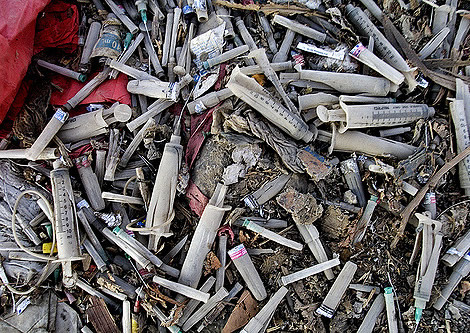
Medical wastes are generated as a result of patient diagnosis and/or treatment or the immunization of human beings or animals. The subset of medical waste that potentially could transmit an infectious disease is termed infectious waste.
The Centers for Disease Control (CDC), the U.S. Environmental Protection Agency (EPA), and the World Health Organization (WHO) concur that the following wastes should be classified as infectious waste: sharps (needles, scalpels, etc.), laboratory cultures and stocks, blood and blood products, pathological wastes, and wastes generated from patients in isolation because they are known to have an infectious disease.
Medical wastes can also include chemicals and other hazardous materials used in patient diagnosis and treatment. In some cases this subset of medical waste is classified as hazardous waste. Hospitals, clinics, research facilities, diagnostic labs, and other facilities produce medical waste.
The bulk of the wastes generated by most health care facilities, however, is municipal solid waste (MSW), or trash. MSW includes large quantities of paper, cardboard and plastics, metals, glass, food waste, and wood. Medical waste, though a smaller portion of the total health care waste stream, is of special concern because of the potential hazards from pathogens that may be present, or from hazardous chemicals.
Risk and Health Care Waste
In the late 1980s there were a series of syringe wash ups on beaches along the East Coast of the United States, which were mistakenly attributed to health care facilities. The federal Medical Waste Tracking Act (MWTA) was passed and the EPA attempted to set standards for managing the infectious waste component of medical waste that they renamed regulated medical waste.
Few states adopted its stringent guidelines. The MWTA expired in the early 1990s, making each state responsible for establishing its own classification and management guidelines for medical waste.
There are very few documented cases of disease transmission from contact with medical waste. The notable exception is needle stick, or “sharps” injuries. Paralleling the concern over beach wash ups of medical waste, was a growing awareness of the increase in HIV-AIDS and other cases of infectious diseases being diagnosed and treated in health care settings.
This, along with a series of events, led to the Occupational Safety and Health Administration (OSHA), which established rules designed to protect health care workers (OSHA blood-borne pathogen standards and universal precautions) by stipulating the need for such personnel to wear protective clothing and equipment, and to take special precautions when handling or disposing of sharps.
The interpretation of rules surrounding worker safety regulations led to some confusion over waste classification, thus causing a greater amount of wastes to be considered as potentially infectious. (For example, under the OSHA universal precautions guidelines, a worker handling a bandage with a single drop of blood on it should wear gloves, but the waste itself would most likely not be classified as infectious).
Noting that there are multiple risks inherent in medical waste including toxic chemicals and radioactive materials, the WHO has chosen to use the term health care risk waste instead of medical waste.
Proper Management, Treatment, and Disposal
There is general consensus among professional health care organizations, the waste management industry, and regulators that proper management starts with the identification of wastes requiring special handling and treatment because of their hazardous nature (biological, chemical, or radioactive). Waste identification is necessary for proper segregation, so that only those wastes needing special treatment and handling are treated. Proper management of all waste streams enhances worker safety, protects the environment, and can reduce costs.
Wastes that are deemed potentially infectious may be treated prior to disposal by a number of different technologies that either disinfect or sterilize them. These technologies include incineration, steam sterilization, dry heat thermal treatment, chemical disinfection, irradiation, and enzymatic (biological) processes among others. In 2002 there were more than one hundred specific technologies in use. In order for treatment systems to work properly, distinctive protocols for the classification and segregation of wastes must be in
place.
Most treatment technologies for infectious wastes cannot process chemical or radioactive waste. Misclassification and inappropriate treatment of infectious wastes can result in significant harm to the environment and human health; for example, residual chemotherapeutic agents are should not be treated in autoclaves, but rather should be set aside and treated by either incineration (hazardous waste incinerators) or chemically neutralized where feasible.
The EPA has cited medical waste incinerators as among the top sources of mercury and dioxin pollution. New regulations governing the operation of, and emissions from, medical waste incinerators in the late 1990s have resulted in the closure of most such incinerators in the United States. Other countries such as the Philippines have completely banned incineration because of its adverse environmental impacts.
The health care industry is rapidly changing in ways that continue to have significant impact on the volume and characteristics of wastes produced.
- New (e.g., laproscopic and laser) surgical techniques result in procedures that produce very little blood-contaminated waste.
- Advances in cancer treatment have produced many drugs used in chemotherapy that are highly toxic in small quantities, producing more hazardous chemical wastes.
- Patient residence time in hospitals has declined. Procedures that previously required an extended stay now commonly occur on an outpatient basis without necessitating an overnight stay.
- Home care continues to grow, shifting the location of service delivery. Dialysis, chemotherapy, and hospice care are but a few examples of health care that often take place in a home setting, the result being that many wastes regulated as infectious or hazardous waste in a hospital are being disposed of as ordinary trash at curbside. (Household waste is exempt from many regulations.)
- As hospitals close their incinerators, biohazardous and sometimes (inadvertently) hazardous wastes are being hauled significant distances to centralized facilities for treatment and disposal.
All of these changes represent new challenges in continuing efforts to properly define, classify, regulate and manage medical wastes.
Mercury
![]() |
| Mercury |
Mercury is a metal with chemical similarities to zinc and cadmium. The metal is liquid at room temperature, with a freezing point at –31°C, and it is one of the most volatile metals. It occurs as the element Hg0 and as the mercuric ion Hg++, which has a great affinity for reduced sulfur (sulfide, S=).
Most mercury ore deposits consist of the very insoluble mineral cinnabar (HgS), with little droplets of elemental Hg. Mercury also occurs as impurities in many other ore minerals, creating mercury contamination when these minerals are mined or processed. Most common rocks have very low Hg contents, about ten to one hundred parts per billion (ppb) Hg .
Elemental mercury is barely soluble in pure water, with only twenty-five ppb Hg dissolving at room temperature, but it is more soluble at higher temperatures. The mercuric ion is very soluble in most ambient waters, but very insoluble in the presence of sulfide. Natural enrichments of mercury occur in and around ore deposits and in geothermal hot spring areas and volcanoes.
Bacteria in coastal waters convert inorganic Hg ions back into the elemental state, which then evaporate from the water back into the atmosphere. The physical transport of mercury from ore regions and the vapor transport from geothermal areas and the oceans provide the natural background contamination of mercury.
Mercury is a toxic element that damages the human nervous system and brain. Elemental mercury is less dangerous when it is ingested than when it is inhaled. The use of mercury in felt-making led to widespread elemental mercury poisoning of hatmakers (“mad as a hatter”), which was expressed by tremor, loss of hair and teeth, depression, and occasional death. The organic forms of mercury—methylmercury compounds, CH3Hg+ and (CH3)2Hg— are very bioavailable or are easily taken up by living organisms and rapidly enter cells, and are therefore the most hazardous.
Minamata disease was an episode of mercury poisoning of a small coastal community in Japan (1954) through the direct industrial release of methylmercury in the bay. Another infamous episode of mercury contamination occurred in Iraq, where people ate wheat that was treated with a mercury-containing fungicide.
The continuous flux of mercury from the atmosphere results in the low level of mercury pollution nationwide. A small fraction of the Hg++ from atmospheric deposition is converted by bacteria into the very dangerous methylmercury form. The methylmercury is then taken up by the lowest life forms and makes its way up the food chain and bioaccumulates in the larger fish.
As a result, large predator fish such as bass, tuna, shark, and swordfish have the highest levels of Hg in the methylmercury form. Most states in the United States have advisories for eating only limited amounts of freshwater fish. Limiting intake of mercury-contaminated fish is especially important for pregnant women and young children. The current U.S. legal limit for Hg in fish for consumption is 1 ppm.
Limits for Hg in soils vary from state to state but generally range from 10 to 20 ppm, whereas the Environmental Protection Agency’s limit for drinking water is 2 ppb Hg. The Occupational Safety and Health Administration limits for Hg in the air in the workplace (for an eight hour average) are 0.01 mg organic Hg/m3 air.
Modern sources of mercury contamination from human activities are subdivided into the following groups:
- High-temperature combustion processes such as coal-fired power plants, incineration of solid household waste, medical waste, sewage sludge, and ore smelting.
- Industrial waste effluents, such as from chlor-alkali plants that use liquid mercury as electrodes.
- Effluents of wastewater treatment plants.
- Point sources of specific industries, many of them no longer active today (such as hat making, explosives, mercury lights, herbicides, and plastics).
An overview of modern anthropogenic Hg fluxes into the environment shows that more than 80 percent of mercury is injected into the atmosphere through such combustion processes as coal-fired power plants.
The combustion releases mercury as elemental vapor into the atmosphere, where it has an average residence time of about one year before it is oxidized to the mercuric form. The oxidized mercury attaches itself to small dust particles and is removed by wet and dry atmospheric deposition.
As a result of this massive injection of Hg into the atmosphere—more than 100 tons of Hg per year in the United States in the late 1990s—the contaminant is distributed all over the globe. Even the polar ice caps show evidence of mercury contamination over the last 150 years, from atmospheric dispersal and deposition from anthropogenic sources. There are almost no places on earth that are not contaminated by anthropogenic mercury.
Mercury contamination is a matter of ongoing concern, and an extensive study was done for the U.S. Congress to summarize the sources, pathways, and sinks of mercury in the outdoor environment. There are several initiatives to limit the anthropogenic flux of Hg from coal-fired power plants, such as switching to mercury-poor coals and scrubbing the stack gases.
Limiting or banning the production of mercury-containing materials, including switches, thermometers, thermostats, and manometers, both in the household as well as in the medical profession, would also reduce the mercury recycled back into the atmosphere from garbage incineration.
Subscribe to:
Posts (Atom)